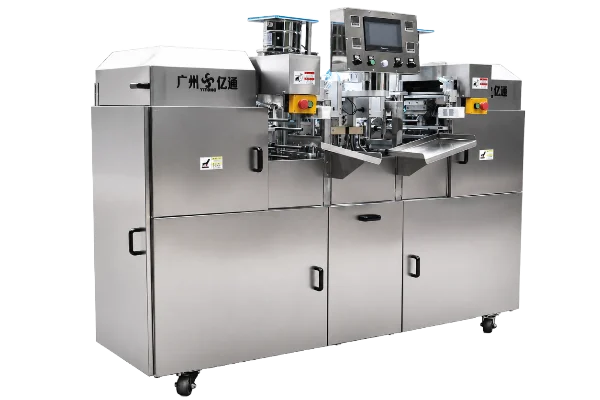
“Biscuit” sounds like a useful product description until a buyer tries to turn it into a machine brief. A round, dry snack piece, a deposited cookie and a rotary-moulded hard biscuit can all appear on the same supermarket shelf. They do not enter a line through the same forming station. The difference is visible before baking: one product begins as a dough sheet, one is placed as a soft deposit, and one is pressed into a mould.
That is why a biscuit making machine should be selected from the forming method first, then checked against output, utilities and the handoff to packing. This guide separates the main routes, explains the dedicated dough-sheet press, cutter and rounder process used for small round baked pieces, and identifies the questions that prevent a capacity figure from masking a wrong machine class.
What a biscuit making machine does before the oven
In a complete line, the forming section gives dough the geometry that the oven must preserve. UDTECH describes its dedicated small-biscuit train as mixer, dough-sheet press and cutter, rounder, lifting conveyor, arranger, electric tunnel oven and vibrating screen. The oven is therefore one process station in a route that already decided the piece’s diameter, mass and shape. A bakery that starts with oven length alone can miss the more basic question: can the upstream section make the intended piece consistently?
For a buyer, “forming method” means the controlled action that creates the piece before heat sets it. That is more useful than broad labels such as hard or soft biscuit because it identifies the contact surface, the dough condition and the change that must happen when the product shape changes. Capacity comes later.
Forming comes first.
Sheet press, cutting and rounding for small baked pieces
The sheet-press/cut/round route gauges dough into a sheet, cuts portions, then rolls each portion into a ball-like form before the product is spread across a belt. On the UDTECH YT-XMT800 train, the arranger follows the rounder so pieces enter an electric, temperature-controlled tunnel in an even distribution. This is a physical sequence: pressing establishes sheet thickness, cutting establishes the portion, and rounding creates the finished form.
Where it stops: it does not turn a patterned hard biscuit or a soft deposited cookie into the same product by changing a setting. The route is intended for small round baked snack pieces. A different outline changes the cutter and the downstream spacing problem; a product that needs a mould impression or a wire-cut head needs another forming class, even when its daily mass target looks similar.
Rotary moulding for hard biscuits
A rotary moulder presses dough into engraved moulds and releases a patterned piece to the baking surface. It suits the familiar hard, sweet-biscuit family because the mould face carries the design and the dough leaves as a formed sheet of individual pieces. That is a different operation from cutting a plain sheet and then rounding each cut portion.
Where it stops: a rotary moulder is not a shortcut to a rounded snack ball. Its mould geometry, release behaviour and dough handling are built around the engraved-forming task. If the finished product must become round after cutting, the buyer should specify sheet pressing, cutting and rounding rather than ask a moulder to imitate that route.
Depositing and wire cutting for cookies
Deposited and wire-cut cookies begin with a softer dough that is portioned rather than sheeted. The depositing head determines the individual piece, while a wire-cut arrangement severs the dough at a controlled position. These are useful methods for cookie forms whose softness or inclusions would make a sheet-and-round sequence inappropriate.
Where it stops: neither route is present on the dedicated UDTECH small-biscuit train. That line has no wire-cut head, and its published process is not a general cookie platform. Stating this boundary before quotation protects both the buyer and the manufacturer from treating “biscuit” as a promise of every biscuit subtype.
Why a biscuit production line is not a steamer
The “mini steamed bun” trade name causes a second, more consequential confusion. The YT-XMT800 is baked in an electric tunnel; the published train has no steam cabinet and no proofing section. Its product name does not describe a steaming process, and its heat stage is not interchangeable with a bun steamer.
That distinction changes the utility and layout discussion. A buyer whose product truly needs steaming must define the steamer and proofing requirement in the first enquiry. A buyer whose piece is a dry baked snack instead needs to confirm the electric tunnel, the belt route and the screening handoff. Similar words do not create the same process.
Product sample, cutter and rounder: the three linked specifications
The useful sample is not just a photograph for a sales file. Its finished diameter and piece weight determine whether the cutter can make the initial portion and whether the rounder can create the stated form without turning the next station into a trial-and-error exercise. UDTECH asks for the finished product, diameter and weight because those details govern the forming route before a model is selected.
Here is the counterintuitive point: a larger capacity request cannot repair a poor product match. Extra belt length or extra oven duty may raise a nominal output, but it does not give a sheet press a wire-cut function or give a rounder a mould pattern. The right capacity calculation begins only after the product route is fixed and the finished sample has been reviewed.
What the published line figures do and do not say
UDTECH publishes the YT-XMT800 as an eight-machine train over 55 m with 418 kW installed and a rated output of 4,000 kg per 24 h. Those are useful scope figures: they identify one complete mixer-to-screen route, its straight-run consequence and its connected electrical load. They are not a recipe, a product guarantee or evidence that every biscuit type fits the line.
The last qualification matters when comparing quotations because a quoted oven may be shorter because it excludes mixing, forming, arranging or screening, while a lower power number may refer only to a motor load and leave the thermal duty elsewhere in the document. Comparing like for like means first marking the process boundary, then matching the same output basis to the same product form.
Release and guarding are process questions too
The American Society of Baking’s wafer reference links release to both formulation and baking: fat assists release while emulsifiers help steam leave the product during baking. The example is from wafer production, but the practical lesson travels to formed baked pieces. Release is not solved only at the discharge end; product composition, the forming surface and the heat path must be reviewed as one operating system.
Moving conveyors, cutters and arranging equipment also create a design question beyond output. OSHA’s bakery-equipment rule requires gears to be enclosed and calls for lubrication from a safe location. This establishes a guarding consideration for a destination-site specification; it does not claim that a particular supplier, line or plant holds a certification.
Before requesting a biscuit making machine quotation
A usable request states the finished product first: a sample or drawing, finished diameter, piece weight, surface pattern, texture and whether the product is baked or steamed. It then identifies the route required: sheet press/cut/round, rotary moulding, or depositing and wire cutting. Finally, it states target output on one time basis, available straight run, electrical supply, cooling or packing handoff, and the guarding rule that applies at the installation site.
For a small round baked snack, an UDTECH biscuit production line is best understood as a defined sheet-to-screen route rather than as a generic biscuit machine. That framing makes the next decision clear: verify the sample against the cutter and rounder before treating output as the deciding number.