
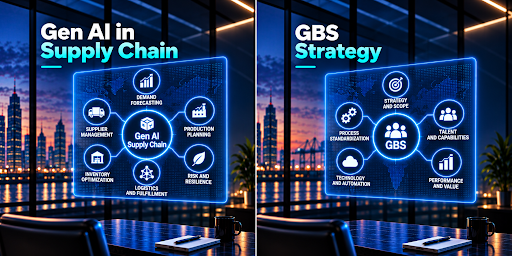
Supply chain leaders face increasing pressure to improve resilience, control operating costs and manage complex global networks. At the same time, Global Business Services (GBS) organizations are expanding beyond transactional support to provide analytics, process expertise and enterprise-wide capabilities. Gen AI in Supply Chain offers an opportunity to connect these priorities by improving access to operational information, automating knowledge-intensive work and supporting faster decisions.
A well-defined GBS strategy can provide the operating model, governance and shared capabilities required to scale these technologies across business units and regions. By combining standardized processes, reliable enterprise data and intelligent automation, organizations can strengthen supply chain performance while improving service efficiency.
This article explores how Gen AI in Supply Chain and GBS strategy work together, their applications, business benefits and implementation priorities.
What is Gen AI in Supply Chain?
Gen AI in Supply Chain refers to the application of generative artificial intelligence across planning, sourcing, manufacturing, inventory management and logistics.
These capabilities can interpret natural language, summarize operational information, generate reports and provide conversational access to enterprise knowledge.
Supply chain professionals can use generative AI to investigate planning exceptions, retrieve supplier information and understand operational changes more efficiently.
Unlike conventional automation, generative AI supports activities requiring interpretation and contextual understanding.
Its primary value lies in making complex information easier to access and use within established supply chain workflows.
What is a GBS strategy?
A GBS strategy defines how an organization structures shared capabilities, processes, technology and talent to deliver services across business functions and geographic regions.
Global Business Services commonly includes finance, HR, procurement, IT and selected supply chain activities.
An effective strategy establishes service scope, process ownership, governance, technology requirements and performance measures.
For supply chain operations, GBS can provide centralized analytics, master data management, procurement support and other standardized capabilities.
A strong GBS strategy ensures these services contribute to enterprise performance rather than focusing exclusively on administrative cost reduction.
Why generative AI matters for GBS-enabled supply chains
Supply chain information is frequently distributed across planning systems, procurement platforms, manufacturing applications and logistics networks.
Employees may spend considerable time collecting data, reviewing reports and investigating exceptions.
Gen AI in Supply Chain can reduce this administrative burden by summarizing information and providing easier access to relevant operational knowledge.
GBS can support implementation by providing common data standards, shared technology capabilities and consistent process governance.
This combination helps organizations avoid fragmented AI applications across business units.
Core technologies supporting intelligent supply chains
Several technologies contribute to AI-enabled supply chain operations.
Generative AI
Generative AI can summarize planning reports, supplier information and operational documentation.
Machine learning
Machine learning analyzes historical and operational data to identify patterns and anomalies.
Predictive analytics
Predictive models can help organizations anticipate demand changes, inventory requirements and supply risks.
Intelligent automation
Automation executes repetitive workflows and supports consistent operational processes.
AI agents
AI agents can coordinate multistep activities across enterprise systems while operating within defined permissions.
A GBS strategy can help establish the shared architecture and governance needed to integrate these technologies.
Key applications of Gen AI in Supply Chain
Organizations can apply generative AI across several supply chain activities.
Demand planning
AI can summarize forecast changes, explain relevant demand signals and help planners interpret complex information.
Inventory management
Generative AI can highlight inventory exceptions and provide contextual explanations of stock positions.
Supplier management
AI can summarize supplier contracts, performance information and relevant documentation.
Manufacturing support
Generative AI can improve access to production procedures, maintenance knowledge and operational reports.
Logistics
AI can summarize transportation information, delivery exceptions and potential disruptions.
Supply chain risk management
Generative AI can consolidate operational and supplier information to support faster risk assessment.
These applications demonstrate how Gen AI in Supply Chain can complement established planning and analytical capabilities.
How GBS strategy supports AI implementation
Scaling AI across supply chain operations requires consistent processes, reliable information and clear accountability.
A GBS strategy can support this by centralizing selected capabilities such as data management, analytics, technology support and knowledge management.
For example, a shared analytics team could provide standardized performance information across regions, while local supply chain teams retain responsibility for operational decisions.
GBS can also help coordinate technology investments and establish common implementation standards.
This reduces duplication and supports more consistent AI-enabled service delivery.
Business benefits of combining AI and GBS
When connected to clear operational priorities, generative AI and GBS can create several benefits.
Greater productivity
AI can reduce time spent searching for information, preparing reports and investigating routine exceptions.
Improved process consistency
Shared governance and standardized workflows can reduce unnecessary variation across regions.
Faster decision support
Generative AI can make relevant operational information easier for employees to access and interpret.
Greater scalability
GBS capabilities can support AI implementation across multiple business units without duplicating resources.
Better operational visibility
Integrated data and analytics can help leaders understand supply chain performance more consistently.
Building an AI-enabled GBS operating model
Introducing generative AI can change how supply chain support activities are organized.
Routine reporting, information retrieval and documentation may increasingly be supported by intelligent technologies.
Employees can then focus more capacity on exceptions, process improvement and specialized operational support.
The GBS strategy should define which activities are appropriate for centralized delivery and which require local or business-specific expertise.
It should also establish decision rights between GBS teams and supply chain leadership.
This ensures Gen AI in Supply Chain supports operational requirements without creating unnecessary organizational complexity.
Best practices for implementing Gen AI in Supply Chain
Organizations can improve implementation outcomes by following several principles:
- Identify supply chain processes with meaningful performance gaps.
- Establish current cost, productivity and service baselines.
- Standardize relevant processes before introducing advanced AI.
- Improve supplier, inventory and planning data quality.
- Prioritize use cases based on value, feasibility and risk.
- Integrate AI with existing enterprise platforms.
- Establish clear governance and human oversight.
- Define responsibilities between GBS and supply chain teams.
- Train employees for AI-enabled workflows.
- Measure realized operational and financial outcomes.
These practices help connect AI implementation with broader GBS strategy objectives.
Common implementation challenges
Data fragmentation is a significant barrier because supply chain information often resides across multiple enterprise platforms.
Different regions may also use inconsistent processes, definitions and reporting standards.
Legacy technology can create integration challenges when organizations introduce modern AI capabilities.
Governance is particularly important because AI applications may access commercially sensitive supplier and operational information.
Organizations must also avoid excessive centralization. Some supply chain decisions require local expertise, market knowledge and immediate operational judgment.
A balanced GBS strategy should account for these requirements.
Measuring the value of AI-enabled supply chain services
Organizations should evaluate Gen AI in Supply Chain through measurable performance improvements rather than technology usage alone.
Relevant measures can include planning productivity, exception resolution time, reporting efficiency, operational costs and service quality.
GBS leaders should also evaluate whether shared capabilities reduce duplication and improve process consistency.
Establishing performance baselines before implementation enables organizations to compare actual outcomes with expected benefits.
This helps determine which AI applications should be expanded and which require further improvement.
The future of Gen AI in Supply Chain and GBS
The next phase of supply chain transformation will increasingly involve AI agents capable of coordinating activities across planning, procurement and logistics systems.
An agent could identify an operational exception, retrieve relevant information, initiate an approved analytical workflow and escalate complex decisions to specialists.
GBS may play an important role in managing shared AI platforms, knowledge repositories and governance frameworks.
As these capabilities mature, the GBS strategy will need to address agent orchestration, workforce roles and the division of responsibilities between shared services and operational teams.
Conclusion
Gen AI in Supply Chain creates opportunities to improve knowledge access, operational productivity and decision support across complex supply networks.
A strong GBS strategy provides the shared capabilities, process standards and governance required to scale these technologies effectively.
Organizations that connect generative AI with reliable data, integrated workflows and clear operating model responsibilities will be better positioned to build intelligent, resilient and efficient supply chain operations.