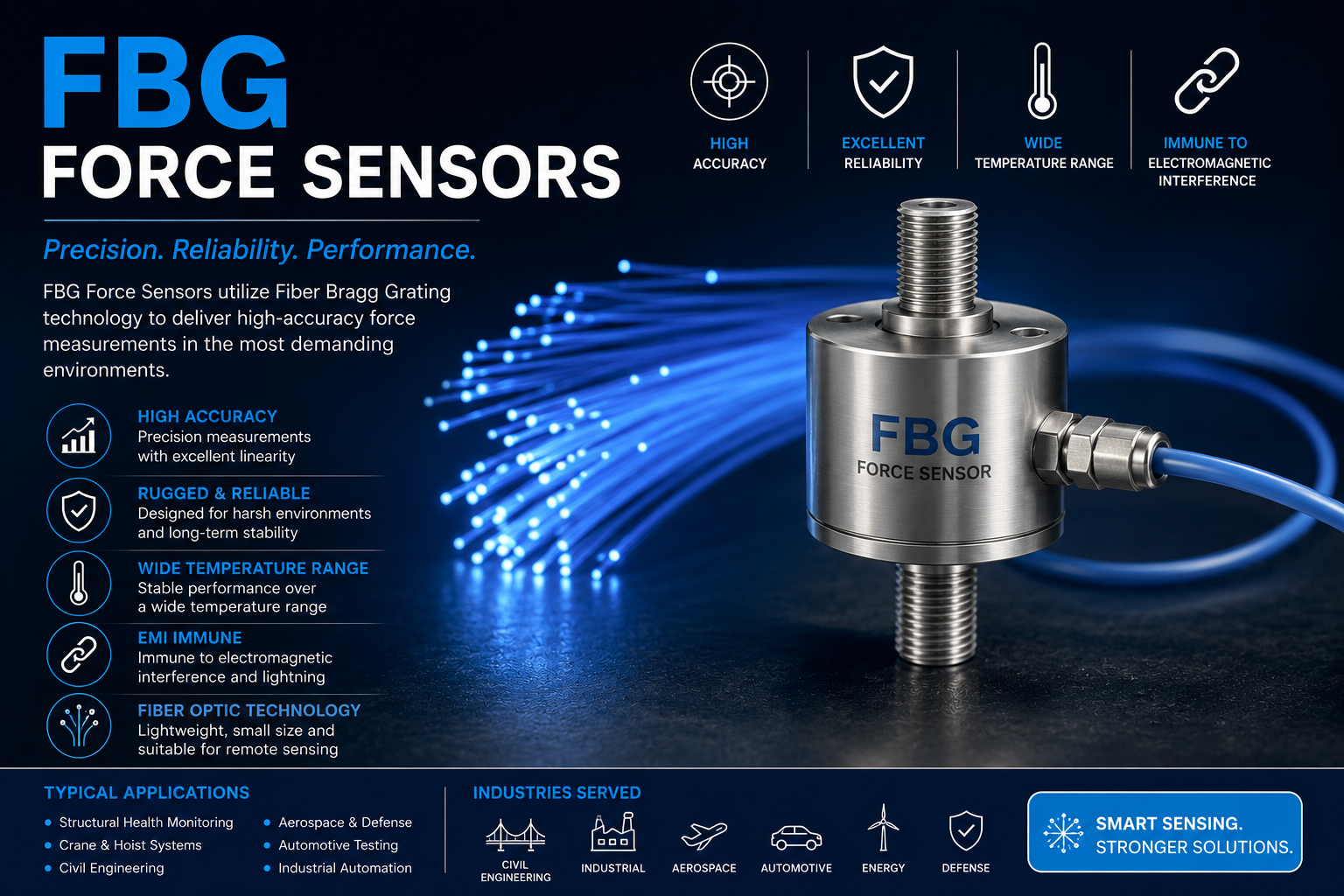
FBG force sensors use Fiber Bragg Grating optical technology to measure force, torque, and pressure with exceptional accuracy—even in extreme environments like high temperatures, radiation zones, and areas with heavy electromagnetic interference. They outperform conventional electronic sensors in harsh, mission-critical applications.
Precision sensing has always been at the heart of high-performance engineering. Whether it’s a robotic arm assembling semiconductor components or a pressure measurement system inside a nuclear facility, the quality of data coming from a sensor can be the difference between a successful operation and a costly failure.
That’s where Fiber Bragg Grating technology enters the picture. Over the past decade, it has reshaped how engineers approach force measurement in demanding environments. Traditional electronic sensors work reliably under normal conditions, but push them into extreme heat, radiation, or electromagnetic interference, and their performance starts to degrade. Optical sensing technology was developed to solve exactly this problem.
This article breaks down what FBG technology is, how it compares to conventional sensing methods, and where it delivers the most value across industries like robotics, aerospace, semiconductor manufacturing, and medical systems.
What Is Fiber Bragg Grating Technology?
A Fiber Bragg Grating is a type of distributed reflector built into a short segment of optical fiber. When the fiber is subjected to mechanical stress—such as force, pressure, or strain—the grating’s reflected wavelength shifts. That shift is measured and converted into precise data about the applied load or force.
Because the sensing mechanism is entirely optical, there are no electrical components involved in the measurement process. This single characteristic gives Fiber Bragg Grating sensors a significant performance edge in environments where electricity is either a hazard or a source of noise.
The underlying physics is elegant: light travels through the fiber, a portion reflects off the Bragg grating, and any change in mechanical stress causes a predictable, measurable change in wavelength. The result is highly accurate, stable, and repeatable measurements.
How Do FBG Force Sensors Differ from Conventional Strain Gauge Sensors?
Standard strain gauge sensors rely on changes in electrical resistance to detect force. They are cost-effective and well understood, making them the default choice across many industrial applications. However, electrical sensors carry inherent vulnerabilities.
Electromagnetic interference (EMI) from nearby motors, high-voltage equipment, or RF sources can corrupt signal quality. In high-temperature environments, thermal drift becomes a persistent calibration challenge. Exposure to radiation can degrade electronic components over time, reducing reliability in nuclear or aerospace settings.
FBG force sensors sidestep many of these limitations. Key differences include:
- EMI immunity: Since optical fibers carry light rather than electrical current, they are completely unaffected by electromagnetic fields. This makes them ideal for semiconductor manufacturing environments, where precision equipment generates substantial electrical noise.
- Temperature compensation: Dual FBG configurations enable real-time temperature compensation, eliminating the thermal drift that plagues conventional load cells operating above standard temperatures.
- Radiation resistance: In nuclear power plants, military systems, and aerospace applications, radiation can disable electronic sensors. Optical sensors are inherently immune to radiation-induced degradation.
- Overvoltage safety: Voltage spikes can permanently damage electronic sensing equipment. An all-optical measurement system is simply unaffected by electrical overvoltage events.
- Water submersion: Properly designed optical sensors can operate in deep submersion conditions for extended periods without performance loss—something few electronic sensors can reliably achieve.
Key Applications Across High-Performance Industries
Robotics and Tactile Force Sensing
Robotic systems handling delicate components—from surgical tools to fragile electronics—require real-time force feedback with high sensitivity. Gripper fingers equipped with force sensors can detect minute changes in gripping pressure, preventing damage to components during automated handling.
In robotic applications, both strain gauge and FBG load cells serve different purposes depending on the operating environment. For standard automation lines, strain gauge sensors deliver reliable performance. For harsh or safety-critical robotic environments, optical sensing technology provides the added durability required.
Semiconductor Manufacturing
Semiconductor fabrication environments are dense with electromagnetic interference. Equipment like plasma etchers, ion implanters, and RF-powered deposition systems generate significant noise that can disrupt electronic sensor signals.
Optical force and pressure sensors perform without interference in these environments, enabling accurate process control without the signal conditioning overhead typically required for electronic sensors in high-noise settings.
Aerospace and Defense
Aerospace systems demand sensors that perform reliably under mechanical stress, vibration, extreme temperature changes, and exposure to radiation during certain mission profiles. The weight and size of sensing components also matter—compact, lightweight designs are essential.
Inline force sensors engineered for aerospace applications combine small form factors with robust resistance to these environmental extremes. The absence of electrical components also reduces the risk of electrical failure cascading into broader system issues.
Medical and Surgical Robotics
Surgical environments present a unique challenge: they combine precision requirements with RF-intensive conditions from imaging equipment like MRI machines. Standard electronic sensors can fail to provide reliable readings in these settings.
Optical force measurement technology, unaffected by RF interference, enables accurate force feedback for surgical robotic instruments—even inside imaging suites. This capability is particularly relevant for minimally invasive surgical systems where precise gripping force control directly affects patient safety.
Industrial Automation and Smart Structures
Modern automation equipment increasingly requires embedded sensing for real-time process control, machine learning feedback, and safety monitoring. Smart bracket force transducers designed as drop-in replacements for T-slotted extrusion systems let manufacturers integrate sensing capabilities into existing machine frames without major redesigns.
These embedded systems generate continuous data that feeds into machine learning models, enabling predictive maintenance and adaptive process control across production lines.
Choosing the Right Sensor Technology for Your Application
Not every application requires optical sensing. For general industrial use without extreme environmental conditions, strain gauge load cells remain cost-effective and well-supported. The decision comes down to operating environment and performance requirements.
Choose optical force measurement technology when your application involves:
- Temperatures above 200°C
- High radiation exposure
- Strong electromagnetic or RF interference
- Submersion in liquid environments
- Risk of electrical overvoltage
For standard automation, assembly, and testing applications operating within normal environmental parameters, conventional strain gauge sensors continue to deliver strong results.
What the Next Generation of Force Sensing Looks Like
Force sensing is evolving from a passive measurement function into an active intelligence layer. Sensors are no longer just collecting data—they’re feeding real-time information into AI systems, enabling machines to adapt, learn, and respond dynamically to changing conditions.
EV battery pack testing is one example of this shift. Force sensing matrices capable of monitoring pressure distribution across large battery assemblies give engineers critical data for both quality assurance and long-term battery health management.
As robotics, autonomous systems, and precision manufacturing continue to advance, the demand for sensors that perform reliably in the most demanding environments will only grow.
Take Your Sensing Capabilities Further
Whether you’re designing a robotic system, building automation equipment, or engineering a solution for aerospace or medical use, the sensing technology you choose shapes everything downstream—data quality, system reliability, and operational safety.
Companies like LILIKOI innovation are pushing the boundaries of what’s possible with advanced force measurement solutions, combining expertise in strain gauges, load cells, and FBG force sensors to serve industries where standard solutions simply aren’t enough.
Frequently Asked Questions
What are FBG force sensors used for?
They are used to measure force, torque, and pressure in environments where conventional electronic sensors underperform—including high-temperature, high-radiation, submerged, and electromagnetically noisy environments. Common applications include robotics, aerospace, semiconductor manufacturing, and surgical systems.
How accurate are Fiber Bragg Grating sensors?
Fiber Bragg Grating sensors are known for high accuracy and long-term stability. Their optical measurement mechanism avoids many of the drift and noise issues that affect electronic sensors, particularly in harsh operating conditions.
Can FBG sensors operate underwater?
Yes. Properly designed optical sensors are resistant to moisture and liquid submersion, maintaining performance integrity even during extended exposure to deep submersion environments.
Are FBG sensors compatible with standard automation systems?
Yes, though integration typically requires an optical signal interrogator to translate wavelength shift data into usable engineering units. Many modern sensing platforms include this as part of a complete sensing solution.
What is the advantage of dual FBG sensor configurations?
Dual FBG configurations allow for real-time temperature compensation. By measuring both force and temperature simultaneously through separate gratings, the sensor eliminates thermal drift, which is a major source of measurement error in conventional high-temperature load cells.