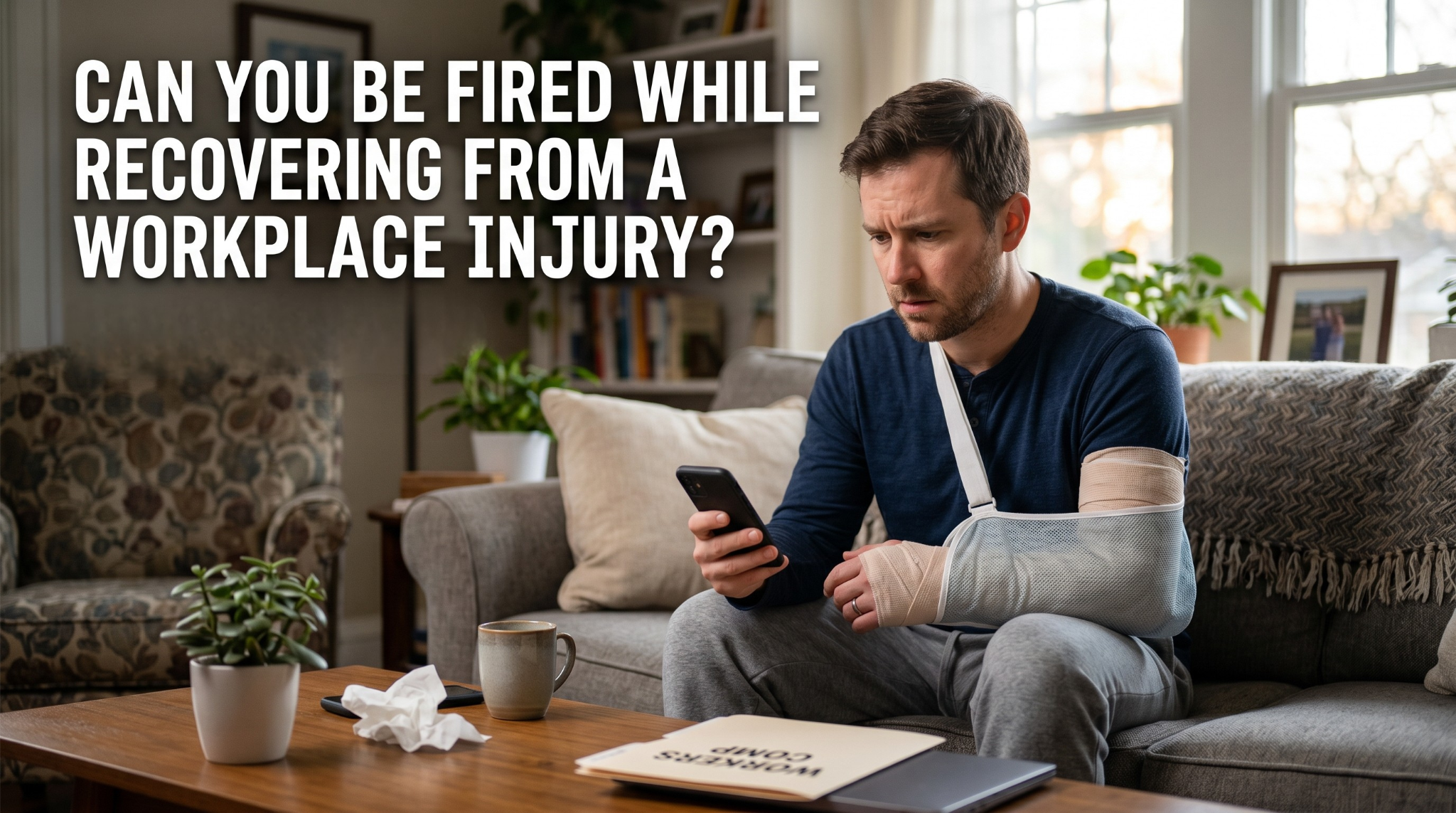
Recovering from a workplace injury is hard enough. Getting fired during that recovery makes everything worse. Termination during a workers’ compensation claim is legal in some cases, illegal in others, and almost always worth reviewing with an experienced attorney.
The U.S. Bureau of Labor Statistics reported nearly 2.8 million nonfatal workplace injuries in private industry in 2022 (BLS, 2023). Many of those workers face the same question: Can my employer fire me while I am still healing? Understanding the difference between a lawful termination and illegal retaliation protects your income, your benefits, and your legal rights.
7 Legally Recognized Reasons an Employer Can Fire You While on Workers’ Comp
Employers keep certain rights even after a workplace injury. Here are the 7 legal reasons they can fire an injured worker:
1. Pre-Existing Performance Issues
Documented misconduct, habitual tardiness, or rule violations that existed before the injury remain valid grounds for termination. The key point is that these issues must be on record before the workers’ comp claim is filed. If the employer suddenly brings up old problems right after the claim, courts may view that as suspicious.
2. Violation of Company Safety Policies
When the injury happened because the worker deliberately ignored established safety rules, the employer can lawfully terminate. The employer must have clear documentation showing that the safety rule was known and communicated to the worker. Without that proof, this reason alone may not hold up in court.
3. Failure to Comply with Post-Injury Protocols
Skipping required medical updates or refusing light-duty assignments without a valid medical reason is grounds for termination. Employers have a right to monitor recovery and expect workers to follow the return-to-work process. If a worker consistently ignores these requirements, the employer may treat it as a resignation or grounds to end employment.
4. Inability to Perform Essential Job Functions
When the worker reaches maximum medical improvement (MMI) and still cannot perform core duties, even with reasonable accommodations, the employer may terminate. MMI is the point where a doctor determines the injury will not improve further, whether or not full recovery has occurred. At that stage, if no suitable modified role is available, termination may be legally justified.
5. Terms of an Employment Contract
Some contracts allow termination after a defined period of medical absence. Workers should read their employment agreement carefully, especially clauses related to leave duration and job protection. If such a clause exists and was agreed upon before the injury, the employer may rely on it to end the employment.
6. Business Restructuring or Layoffs
A genuine company-wide reduction in force unrelated to the injury can be a lawful reason for termination. The employer must show that the layoff would have happened regardless of the workers’ comp claim. If the injured worker is the only one let go while others in similar roles are kept, that pattern can indicate retaliation rather than a real restructuring.
7. Failure to Notify the Employer of Medical Status Changes
Workers must keep their employer informed about recovery progress and any changes to their ability to work. Failing to provide updates when required can give the employer a legitimate reason to end the employment relationship. Always respond to employer requests for medical status updates in writing so there is a clear record.
5 Situations Where Firing an Injured Worker Is Illegal
Every U.S. state bans retaliation against workers who use their legal rights. A study in the American Journal of Industrial Medicine found workers who filed claims faced much higher rates of job loss than those who did not (Azaroff et al., 2002).
Here are the 5 clearest cases where firing is illegal:
- Direct retaliation for filing a workers’ compensation claim: the most common case, especially when the firing comes right after the claim
- Termination for seeking legal representation: Firing someone for talking to or hiring a workers’ comp attorney is illegal in most states
- Discriminatory termination: using the injury as an excuse to fire someone because of age, race, sex, disability, or another protected trait
- Coercive termination to avoid paying benefits: firing a worker to avoid paying for their medical care or lost wages leads to serious legal penalties
- Termination in violation of the FMLA or ADA: workers under the Family and Medical Leave Act or the Americans with Disabilities Act have federal rights that protect them, even in at-will states
Do You Still Receive Workers’ Comp Benefits After Being Fired?
Yes. Losing your job does not stop your workers’ comp benefits. Benefits are based on your injury, not your job status. Here are the 3 key rights you keep after being fired:
- Medical benefits: your treatment goes on until your doctor clears you or you reach MMI
- Temporary total disability (TTD) payments: you still get wage replacement while you cannot work, even after losing your job
- Vocational rehabilitation: if you cannot go back to your old job, you may get help with retraining and finding new work
If you were fired for a real, non-retaliatory reason, you may also qualify for unemployment at the same time. State law decides if that is allowed.
The Role of At-Will Employment in Workplace Injury Terminations
Most U.S. states follow the at-will employment doctrine. That means your employer can fire you for almost any reason, as long as it is not illegal. Many injured workers think their job is safe because they are healing. That is not always the case.
Even in at-will states, your employer cannot fire you for these 4 things:
- Filing or planning to file a workers’ comp claim
- Testifying in a co-worker’s workers’ comp case
- Reporting unsafe conditions to OSHA or a manager
- Asking for a reasonable accommodation for your work injury
If you have an employment contract, a union agreement, or a detailed employee handbook, your protections may be stronger.
What to Do Immediately If You Are Fired While on Workers’ Comp?
Move fast. Here are the 8 most important steps to take right away:
- Document everything: write down the date, time, and what was said when you were fired, and keep all written notices.
- Do not sign anything: severance papers often include language that takes away your right to sue for workers’ comp or wrongful termination.
- Keep all medical appointments: skipping visits can be used against you to cut off your benefits.
- Save all communications: keep every email, text, and voicemail from your employer about your injury or job.
- Request your personnel file: most states let you see your own records, which can show if any issues were added after your claim.
- Apply for unemployment benefits: In many states, you can collect unemployment and workers’ comp wage replacement at the same time.
- Tell your workers’ comp insurer: the claims adjuster on your case needs to know you were fired right away.
- Call a workplace injury attorney: there are legal deadlines for filing retaliation claims, and waiting too long can cost you your case.
Can You Sue Your Employer for Firing You While Injured?
It depends on your state and whether your employer has workers’ comp insurance. In most states with required coverage, workers’ comp is the only way to seek money for the injury itself. But a retaliation claim is a separate lawsuit. It runs on its own, outside the workers’ comp system.
If you win, you may recover:
- Back pay: Wages you lost from the day you were fired until the case is resolved
- Front pay: Money for future wages you will miss because you cannot find a similar job
- Compensatory damages: Money for emotional distress and other personal harm
- Punitive damages: Extra money in serious cases where the employer clearly meant to cause harm
- Attorney’s fees: Many wrongful termination laws let you recover your legal costs if you win
Reasonable Accommodations: Your Right to Return to Work
Before firing you, your employer must try to help you stay on the job. The Americans with Disabilities Act (ADA) requires employers with 15 or more workers to go through an interactive process to find reasonable accommodations.
The U.S. Equal Employment Opportunity Commission says failure to provide accommodations is one of the most common ADA violations.
The 5 most common accommodations for injured workers are:
- Modified duty or light-duty assignments: Short-term work that fits within your medical limits
- Schedule modifications: Changed hours or extra breaks for your treatment visits
- Ergonomic equipment: Chairs, desks, or tools that take pressure off your injured area
- Remote or hybrid work arrangements: Working from home if your role allows it
- Extended medical leave: More unpaid time off beyond FMLA as a short-term fix
If your employer skips this process and fires you instead, they may face claims under the ADA and state laws.
How State Law Shapes Your Rights After a Workplace Injury Termination?
Workers’ comp law is state-specific. Texas, California, New York, and Florida all have different rules. Some states require employers to wait before firing an injured worker. Others need written notice first.
Key things that change by state:
- How “retaliatory discharge” is defined and what proof is required
- Whether workers’ comp is the only remedy or if a tort claim is also available
- Filing deadlines, which range from 90 days to 3 years
- Whether undocumented workers are covered
- How FMLA and state family leave laws overlap with workers’ comp.
Only a local attorney can tell you which protections apply in your state.
Protect Your Rights with the Law Office of Edward Seplavy
Losing your job while still hurt is one of the hardest things a worker can face. At the Law Office of Edward Seplavy, our workers comp attorney New York helps injured workers know their rights, fight illegal firings, and get the full compensation they deserve.
Do not wait. Evidence fades. Deadlines pass. Insurers push hard. The sooner you talk to a workers’ comp attorney, the better your chances. Contact the Law Office of Edward Seplavy today for a free, confidential case review. Your injury was not your fault. Your firing may not be legal. Let us fight for you.