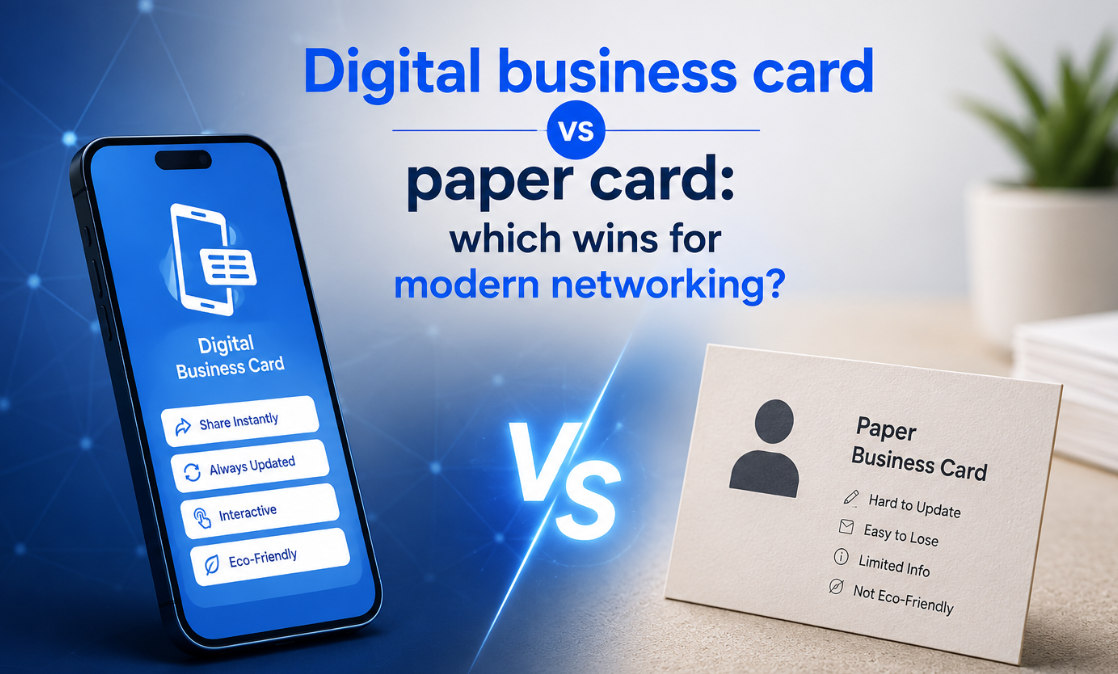
Here is a number worth sitting with for a moment. 88% of paper business cards are thrown away within one week of being received. You spend money designing them, printing them, carrying them everywhere and nearly nine out of ten end up in the bin before the week is out.
That single statistic tells you a lot about where professional networking is heading in 2026. But before we declare a winner, let us look at both sides honestly. Paper cards have been around for centuries for a reason. Digital cards are taking over for a reason too. This comparison covers both fairly, with real data, and without the hype.
What Is a Digital Business Card and How Is It Different From Paper?
A paper business card is a printed card containing your name, job title, contact details, and company information. You hand it to someone physically and hope they keep it.
A digital business card is an online profile containing the same information plus clickable links, social profiles, a portfolio, video, and more that you share via a QR code or direct link. The recipient opens it in their phone browser instantly. No printing. No carrying. No expiry date.
Digital business cards leverage technology to make networking faster, richer, and more measurable. You can edit your information anytime and changes are instant and apply everywhere your card is shared.
That last point is what changes everything. A paper card is frozen in time the moment it is printed. A virtual business card is always alive and always current.
The Numbers Tell the Story
Before getting into the detailed comparison it helps to understand the scale of what is actually happening in the market right now.
The global digital business card market hit $238.75 million in 2026 growing at 12.2% annually while paper card printing has flatlined.
37% of small businesses and 23% of individuals already use digital business cards. Switching to digital cards can cut networking costs by up to 80% for small businesses.
Digital card recipients are 16% more likely to convert into customers compared to those who receive paper cards.
These are not small numbers. The shift is real and it is accelerating every single year.
Head-to-Head Comparison Table
| Feature | Digital Business Card | Paper Business Card |
| Cost | Free to very low | $1.50–$2.50 per card + design + shipping |
| Update information | ✅ Instant one click | ❌ Reprint entire batch |
| Eco-friendly | ✅ Zero waste | ❌ Trees, ink, shipping, landfill |
| QR code sharing | ✅ Built in | ❌ Not included |
| Analytics | ✅ See who viewed your card | ❌ Zero visibility |
| Works online | ✅ Share via email, WhatsApp, LinkedIn | ❌ In person only |
| Works offline | ✅ QR code displayable offline | ✅ Always works |
| Multiple links | ✅ Website, social, portfolio, video | ❌ Text only |
| First impression | ✅ Tech-savvy and modern | ✅ Tangible and personal |
| Runs out | ❌ Never | ✅ Runs out regularly |
| Gets lost | ❌ Never | ✅ Very easily |
| CRM integration | ✅ Yes on most platforms | ❌ Manual entry only |
| Recipient needs app | ❌ No opens in browser | ❌ No just take the card |
| sharing | ✅ Available | ❌ Not available |
| Follow-up rate | ✅ 30% higher | ❌ Lower |
| Customizable anytime | ✅ Yes | ❌ Reprint required |
Cost: Digital Wins Clearly
Let us talk about real money. Paper cards cost about $2 per card when you factor in design, printing, and shipping. Companies switching to digital business cards report up to 90% cost reduction over traditional printed cards.
For an individual professional who reprints cards every time something changes, new job, new number, new email those costs stack up fast. For a company with 50 or 100 employees the numbers become significant very quickly.
Over three years a 100-person company spends $19,269 on paper business cards while spending $0 with a free digital plan.
A free digital business card from a platform like ShareEcard costs absolutely nothing to create, nothing to update, and nothing to share. The cost comparison is not even close.
First Impression: Paper Has an Edge
This is where paper cards still hold genuine value. There is something tangible and personal about the physical exchange of a well-designed card. A premium matte card with embossed lettering makes a statement that a QR code on a phone screen cannot fully replicate.
Nearly 39% of people will not do business with someone if they have a cheap-looking business card showing the importance of quality and design.
In-person events like trade shows, conferences, and networking meetings are settings where paper cards are widely expected. A beautifully designed card not only stands out but also bridges the gap with older demographics who may not be as comfortable with digital alternatives.That said a well-designed electronic business card on a modern platform looks equally impressive and adds interactivity that paper never could. The gap between the two is closing fast.
Practicality: Digital Wins by a Mile
Think about the practical realities of paper cards. You run out of them at exactly the wrong moment. You forget them at home. You hand out 200 at a conference and have no idea if a single person followed up. You change jobs and suddenly have 300 cards sitting in a drawer that are completely useless.
Your digital card lives on your phone. You will never run out or leave it at home.
With a contactless card shared via QR code you can share with one person or one hundred people in the same day. Your link never expires. Your information is always current. And the person who scanned your card at an event six months ago still has your latest details automatically.
Environmental Impact: Digital Wins Decisively
This is arguably the most important round in 2026 as sustainability becomes a core professional value rather than a nice-to-have.
An estimated 100 billion paper business cards are produced each year globally and roughly 88% are discarded within a week. Business card production consumes trees and these cards most often end up in landfills releasing methane gas a greenhouse gas 28 times more potent than carbon dioxide.
A 10,000-employee company can save 125 trees, 50,000 gallons of water, 7,425 pounds of waste, and 7,500 pounds of carbon each year simply by switching to digital cards.
For professionals and companies with sustainability commitments or ESG reporting requirements, switching from paper to an eco-friendly smart business card is one of the most visible and measurable green changes available.
Analytics and Follow-Up: Digital Wins Completely
This is where paper cards show their biggest limitation. Once you hand over a paper card you have absolutely no idea what happens next. Did they look at it? Did they save your number? Did they throw it away? You will never know.
Over 50% of digital card views result in some action saving the contact, clicking a link, visiting a website, or connecting on social media.
With a digital business card on platforms like ShareEcard you can see who viewed your profile, when they viewed it, and whether they saved your contact. For sales professionals and anyone who attends networking events regularly that level of insight is transformational. You know exactly who to follow up with and when.
Digital business cards integrated with CRM systems see a 63% increase in lead management efficiency.
Frequently Asked Questions
What is the main difference between a digital business card and a paper card? A paper card is a static printed card that cannot be updated once printed. A digital business card is a live online profile that can be updated anytime and shared instantly via QR code or link. It also includes analytics, clickable links, and multimedia that paper can never offer.
Are digital business cards better than paper cards for networking? For most modern professionals, yes. Digital card recipients are 16% more likely to convert into customers compared to those receiving paper cards and digital cards never run out, go out of date, or get thrown in the bin.
How much do paper business cards cost compared to digital? Paper cards cost about $2 per card factoring in design, printing, and shipping while companies switching to digital report up to 90% cost reduction. A free digital business card from platforms like ShareEcard costs nothing at all.
Do people still use paper business cards in 2026? Yes but usage is declining fast. The digital business card market has grown to $238.75 million globally and 37% of small businesses have already adopted digital cards. Paper printing has flatlined while digital adoption grows at over 12% annually.
What is a virtual business card? A virtual business card is another name for a digital business card, an online profile containing your professional contact details that can be shared via QR code, NFC, or a direct link without printing or carrying any physical card.
Can I use both a paper and digital business card together? Absolutely. Many professionals print a small batch of quality paper cards with a QR code on the back that links to their digital profile. This gives you the tangible first impression of paper with the functionality and analytics of a digital card.
Is a free digital business card with QR code professional enough? Yes. Platforms like ShareEcard provide a completely free digital business card with QR code that looks professional, works on any device, and requires no app download from the recipient making it an excellent choice for professionals at any level.