London recorded its hottest ever temperature in July 2022 — 40.2°C at Heathrow. Heatwaves that were once rare are now happening nearly every year. A Centre for British Progress report found that the temperature on the Central Line has been known to exceed the legal limit for transporting cattle. Meanwhile, only around 5% of British homes have air conditioning, and many commercial buildings run systems that are years overdue for attention. The conversation about climate control in London is no longer optional.
London’s Heat Problem Is Accelerating — and the Stakes Are Real
London’s lack of preparedness for extreme heat could cost the capital over £200 million annually in lost productivity by 2030. As temperatures rise, the city’s building stock—originally designed for a cooler climate—is struggling to maintain liveable conditions without active mechanical cooling.
Consequently, existing air conditioning systems may now be undersized or underpowered for current demands. Without professional servicing, these systems are likely inefficient and more expensive to operate than necessary.
What Air Conditioning Service in London Should Actually Include
There’s a common misunderstanding about what routine servicing involves. Many building owners assume a service means a brief visual check and a filter clean. A thorough air conditioning service london engineers should perform covers considerably more than that — and the difference matters for both performance and compliance.
A proper annual service on a commercial system typically includes:
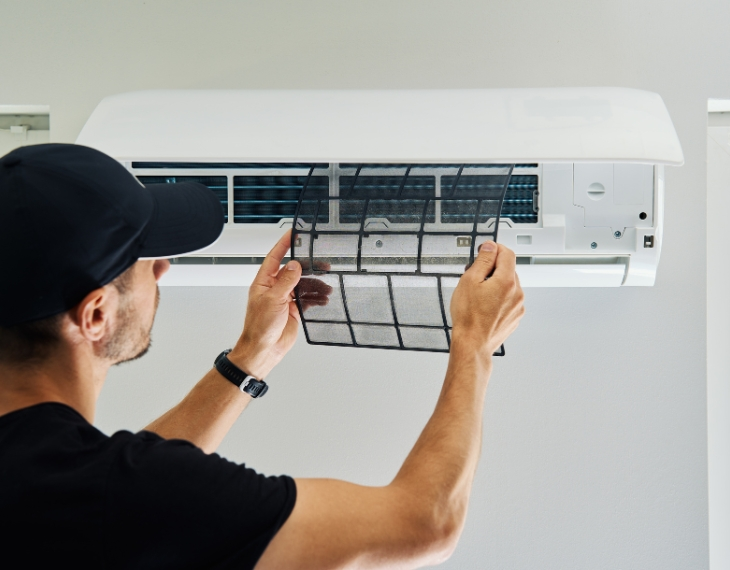
- Filter inspection and replacement — dirty filters restrict airflow, force the compressor to work harder, and reduce cooling capacity. This alone, left unaddressed, can push energy consumption up meaningfully.
- Coil cleaning — indoor and outdoor coils accumulate dust, mould, and biological growth. Fouled coils reduce heat exchange efficiency. In a busy London office, they can also become a source of airborne contaminants that affect air quality.
- Refrigerant level check and leak inspection — low refrigerant is one of the most common causes of poor cooling performance. Any handling of refrigerant requires an F-Gas Category 1 certified engineer; this is a legal requirement, not an option.
- Electrical component testing — contactors, capacitors, and control boards are the components most likely to cause unexpected failure. Identifying a deteriorating component during a service costs a fraction of the emergency callout that follows if it fails mid-July.
- Condensate drainage check — blocked condensate drains cause water damage to ceilings, walls, and floors. It is one of the most avoidable and most frequently occurring faults in London commercial buildings.
- F-Gas record update — all refrigerant-related work must be logged in an F-Gas register. This is a legal obligation under UK F-Gas regulations, and failure to maintain records is a compliance risk that carries financial penalties.
How often? Commercial systems used for both cooling and heating in a London office or retail environment benefit from two service visits per year — one before summer, one before winter. Systems in high-pollution environments, kitchens, or buildings with high occupancy may need more frequent attention. Residential systems used primarily for cooling can typically be maintained on a single annual visit.
Reading the Warning Signs Before Your System Fails
Most air conditioning failures don’t happen without warning. Systems communicate deterioration through performance changes that, if recognised early, give you a window to arrange a repair before the problem becomes an emergency.
Weak or reduced airflow
The most common symptom, and often the most straightforward to address. Causes range from a clogged filter (fixable during a standard service) to a failing fan motor or a restriction in the ductwork. Left unattended in summer, reduced airflow in a London office quickly becomes a comfort complaint, then an HR issue.
The unit runs constantly but the space won’t cool
This is the symptom that should prompt an immediate call. A system running at full capacity but failing to reach the set temperature is either low on refrigerant, has a fouled heat exchanger, or has a compressor issue. All three get worse with continued operation. Running a failing system hard doesn’t help it — it accelerates the damage.
Unusual noises
Rattling, banging, or grinding almost always indicates a mechanical issue — loose fan blades, failing bearings, or debris in the outdoor unit. Hissing is more concerning: it typically indicates a refrigerant leak, which requires an F-Gas certified engineer and should be treated as urgent. Refrigerant leaks don’t self-seal.
Unexplained increase in energy costs
An air conditioning system that is working harder to deliver the same result uses more electricity. If your energy bills have risen without a corresponding change in usage patterns, the system’s efficiency has degraded. An unreliable system can reduce productivity by an estimated 10% during heatwaves — and its inefficiency compounds the problem by driving up the electricity costs associated with running it.

Air Conditioning Repair in London: What to Expect and How to Plan
When a fault requires repair rather than servicing, the two variables that matter most are response time and parts availability. For a commercial property in central London on a hot August day, a failed system is not an inconvenience — it’s a business continuity issue. Staff cannot work effectively above 30°C. Customers won’t stay in a hot retail space. Patients, students, and residents face real welfare risks.
Air conditioning repair london costs vary considerably depending on what has failed. Minor repairs — sensor replacement, control board recalibration, condensate pump replacement — typically fall in the £100–£400 range. Mid-range faults such as fan motor failure or an electrical component issue might run to £400–£800. Major repairs — compressor replacement, refrigerant circuit integrity work, heat exchanger failure — can exceed £1,500 to £3,000 on commercial equipment, and may prompt a genuine conversation about whether repair or planned replacement is the better long-term decision.
The 2025 UK F-Gas regulations tightened restrictions on high-GWP refrigerants significantly. New single-split AC units using refrigerants with a Global Warming Potential above 750 — which includes the widely used R-410A — can no longer be sold in the UK. For buildings with systems approaching end of life, the regulatory clock on planning replacements is already running.
The Case for a Planned Maintenance Agreement
Reactive maintenance — calling an engineer when something breaks — costs more over time than planned preventative maintenance. This isn’t opinion; it’s borne out by every facilities management framework in use. A planned maintenance agreement converts unpredictable capital expenditure into a manageable operational cost, and shifts the system’s risk profile from reactive crisis management to proactive problem prevention.
For London commercial properties, a PPM agreement typically delivers:
- Two scheduled service visits per year, timed to coincide with seasonal demand peaks.
- Priority response for emergency callouts — avoiding the extended wait times that reactive-only customers experience during a summer heatwave, when every engineer in London is simultaneously overwhelmed.
- Discounted rates on any repairs required between scheduled visits.
- Complete F-Gas compliance documentation — records maintained, leak checks logged, and certifications current.
- Early identification of components approaching end-of-life, allowing budgeted planned replacement rather than emergency spend.
None of this eliminates all risk — equipment fails without warning sometimes, even well-maintained equipment. But it reduces the frequency, reduces the severity, and reduces the cost when it does.
Don’t Wait for the Hottest Week of the Year
The busiest period for every air conditioning engineer in London is the week temperatures peak — which is precisely when you do not want to be waiting for a repair slot. A system that has been properly maintained before that week rarely needs emergency intervention during it. Hamilton Air Con provides air conditioning service and repair across London, with over 30 years of experience keeping commercial and residential systems performing when the city needs them most.
Disclaimer: This article is intended for general informational purposes only. Cost estimates cited are indicative ranges based on publicly available market data and may vary significantly depending on system type, size, location, and complexity. F-Gas regulations referenced reflect UK law as of the date of publication. Always consult a qualified F-Gas Category 1 certified engineer for work involving refrigerants. If you experience symptoms suggesting air quality or health concerns linked to your HVAC system, seek professional remediation immediately.
Hamilton Air Con
Author Bio: Matthew ConneryMatthew Connery is the Director of Hamilton Air Conditioning in London. He is a skilled Business Strategist who delivers energy-efficient and cost-saving solutions to commercial and domestic clients from leading air conditioning brands.