Artificial intelligence has quietly become the ghostwriter behind a large share of the content UK businesses publish every day. Marketing copy, internal reports, client emails, even job applications — AI-assisted writing is everywhere, and it’s becoming harder to tell what a human actually wrote versus what a model like ChatGPT or Claude generated.
For businesses, this creates two very different but related problems. The first is verification: how do you know if the content you’re reviewing, whether from a freelancer, an employee, or a job candidate, was actually written by a person? The second is authenticity: if you use AI to draft content yourself, how do you make sure it doesn’t read like a robot wrote it, especially when audiences and search engines increasingly penalise generic AI output?
Lynote, a fast-growing AI productivity platform, has built tools that address both sides of this problem — and they’re gaining traction among UK teams looking for a straightforward, no-nonsense solution.
The Detection Problem
Large language models write in patterns that are subtly but consistently different from human writing. They favour predictable sentence rhythm, safe transitions, and a narrower range of vocabulary. Individually, these patterns are invisible. Collectively, they’re a fingerprint.
This is where Lynote’s AI content detector comes in. Rather than returning a single confidence percentage the way many early detection tools did, Lynote breaks results down at the sentence level, flagging exactly which parts of a document are likely AI-generated, AI-edited, or human-written. It supports content in more than 50 languages and works without requiring an account for basic checks, which matters for HR teams, editors, and hiring managers who need a quick answer without friction.
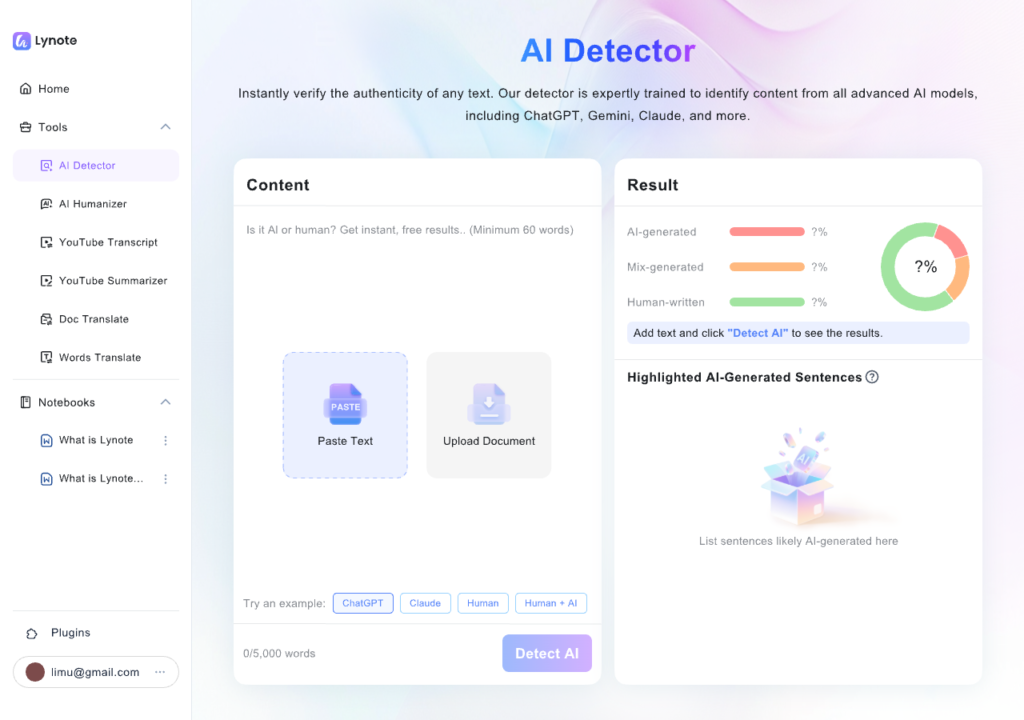
According to Lynote’s internal benchmarks, the tool achieves a 99% accuracy rate against major language models including ChatGPT, GPT-5, Gemini, and Claude — and, notably, it also catches text that has been paraphrased or run through a humanising tool, something many detectors still struggle with.
The Other Side of the Coin
Not every use case is about catching AI content — sometimes it’s about making AI-assisted writing sound less robotic in the first place. A marketer who uses ChatGPT to draft a blog post outline still needs the final copy to read naturally, protect existing SEO rankings, and avoid the flat, repetitive tone that search engines and readers alike are learning to spot.
Lynote’s AI text humanizer was built for exactly this. Instead of simply swapping out words for synonyms — the approach used by older “spinner” tools — it rewrites text at the sentence and paragraph level, adjusting rhythm, smoothing awkward phrasing, and preserving the original meaning and target keywords. Users can choose between three intensity levels: Simple for light edits that keep the original tone intact, Standard for a balanced rewrite, and Enhanced for maximum protection against strict detectors like GPTZero.
The tool supports more than 80 languages and, like the detector, requires no sign-up to get started — a detail that speeds up adoption for busy teams that don’t want another account to manage.
Why This Matters for UK Businesses
The UK’s advertising and content industries have been quick to flag AI-generated material as a compliance and quality issue, particularly in sectors like finance and legal services where accuracy and originality carry real regulatory weight. Tools like Lynote give teams a practical way to check content before it goes out the door, without the cost or friction of enterprise-grade software.
For smaller businesses and agencies in particular, having free, no-sign-up access to both a detector and a humanizer means the barrier to actually using these safeguards drops close to zero. That’s a meaningful shift from a year ago, when most credible AI detection tools sat behind paywalls or required corporate licensing.
The Bigger Picture
As AI writing tools continue to improve, the gap between machine-generated and human-written content will only get harder to spot with the naked eye. Businesses that build simple verification steps into their content workflows now — checking freelance submissions, verifying candidate writing samples, or simply making sure their own AI-assisted drafts read naturally — will be better positioned as scrutiny around AI content continues to grow.
Lynote’s free tier makes that a low-cost experiment worth trying for any team handling meaningful volumes of written content.