
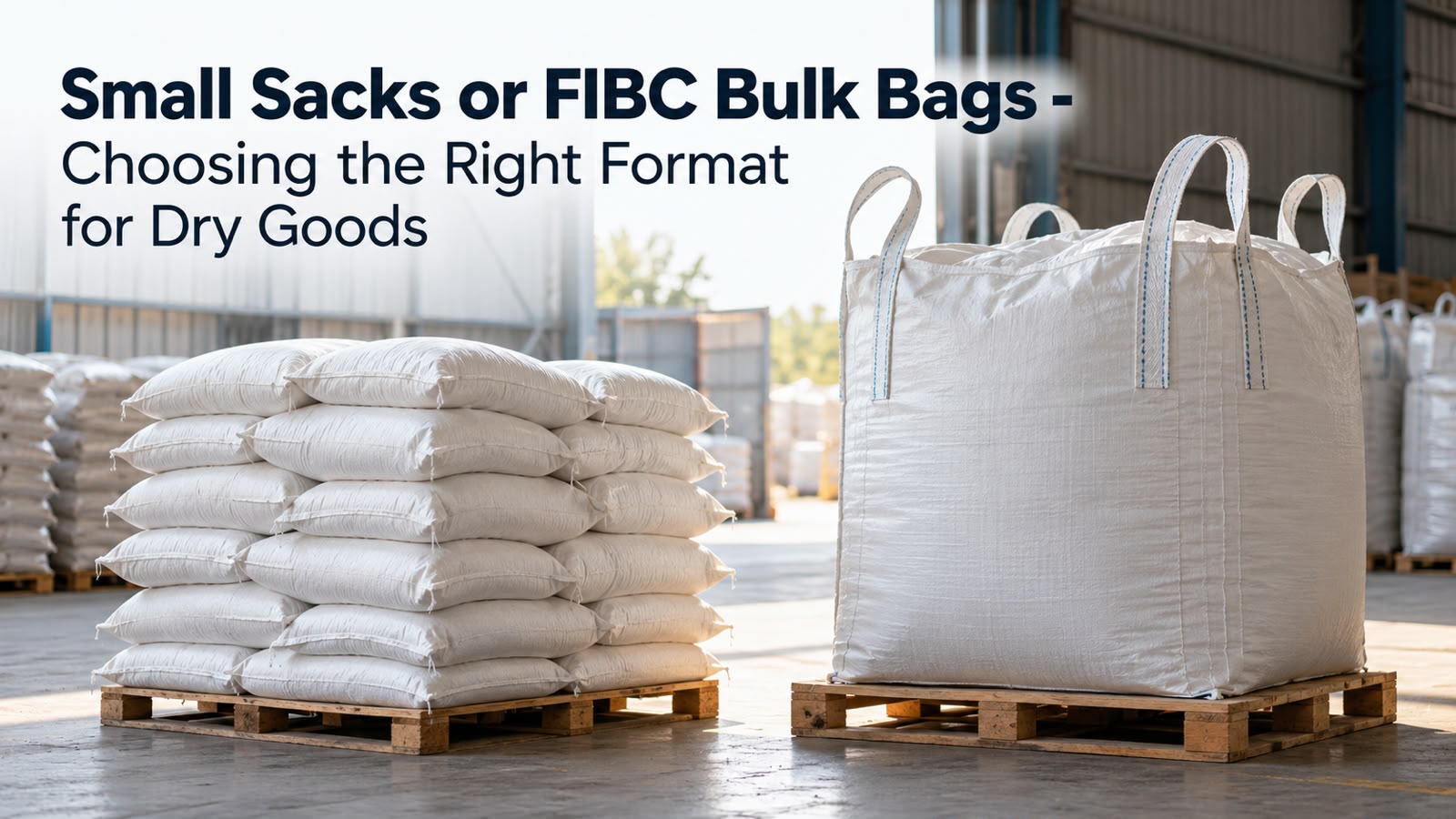
Small woven sacks are practical when dry goods must be divided into manageable quantities for distribution or individual use. Flexible Intermediate Bulk Containers (FIBCs) are generally better suited to moving larger quantities through industrial handling systems. For manufacturers supplying materials to factories, warehouses or processing facilities, fibc bulk bags can reduce the number of separate packages handled during filling, storage and unloading. The better format depends on the entire supply chain rather than the packaging material alone.
Both formats can be manufactured from woven polypropylene, a lightweight material used for industrial packaging. A small PP woven bag typically holds an individual portion of product, while an FIBC combines a much larger quantity into one flexible container fitted with lifting arrangements. Choosing between them requires examining labor requirements, available equipment, warehouse organization, product characteristics and the customer’s receiving process.
The Difference Between Small Sacks and Bulk Containers
The defining difference is the quantity handled as a single packaging unit. Small sacks allow goods to be counted, stacked, distributed and opened individually. They work particularly well when customers require smaller portions or when products pass through several distribution stages before reaching their final destination.
FIBCs are designed for bulk movement. Their construction incorporates lifting features that allow suitable mechanical equipment to move filled containers. Depending on the design, filling and discharge arrangements can also connect with industrial material handling systems.
This distinction affects more than transportation. It influences how workers fill packages, how warehouses organize inventory and how customers transfer materials into production equipment.
Small Sacks vs FIBCs at a Glance
| Decision Factor | Small Woven Sacks | FIBC Bulk Bags |
| Typical application | Individual portions and divided distribution | Large quantities of dry bulk materials |
| Filling process | Repeated filling and closing of individual sacks | Bulk filling into fewer containers |
| Handling method | Individual handling or palletized movement | Mechanical lifting using suitable equipment |
| Warehouse organization | Stacked sacks with flexible order picking | Larger inventory units requiring bulk handling access |
| Packaging waste | More individual packages for an equivalent quantity | Potentially fewer packaging units and closures |
| Customer requirements | Suitable for customers needing smaller quantities | Suitable for receivers equipped for bulk unloading |
Neither format provides an automatic advantage in every category. A warehouse handling full industrial loads may benefit from FIBCs, while a distributor preparing small customer orders may find individual sacks more convenient.
How Filling and Handling Labor Changes
Packaging format directly affects the number of filling and closing operations. Consider a production batch containing 1,000 kg of dry material. Packing that batch into 25 kg sacks requires 40 individual packages. Filling the same quantity into one appropriately specified bulk container requires one main packaging unit.
This example illustrates the difference in handling frequency, not a guaranteed productivity improvement. Actual efficiency depends on filling equipment, material flow characteristics, package closures and the steps required before shipment.
Smaller sacks can operate efficiently on automated filling lines. They are also practical where workers must select individual packages for different orders. However, repeated handling creates additional opportunities for torn packaging, incorrect counts and material spillage.
Bulk containers can simplify material movement when a facility has suitable lifting equipment. Forklifts or other approved systems can transfer filled bags without workers repeatedly lifting individual sacks. Safe handling still depends on the bag’s specified working load, lifting configuration and compatibility with the equipment.
What Happens to Pallet and Warehouse Space?
Warehouse efficiency depends on usable storage volume, accessibility and the number of movements required to process inventory. Small sacks can be arranged in layers on pallets, allowing facilities to build loads that suit their storage systems. Individual packages can also be removed without necessarily opening the entire inventory unit.
FIBCs consolidate material into larger handling units. This can reduce the number of individual packages that warehouse personnel must organize and count. Certain bulk bag constructions also help maintain a more controlled shape after filling.
Nevertheless, larger bags do not automatically save floor space. Storage efficiency depends on bag dimensions, product density, filling behavior, stacking suitability and warehouse layout. Some operations may need pallets or dedicated support systems for safe movement and storage.
The practical comparison should examine how much usable material can be stored within a defined warehouse area while preserving safe access and product identification.
Does Bulk Packaging Reduce Packaging Waste?
Using fewer individual packages can reduce the number of closures, labels and empty sacks generated for an equivalent quantity of product. A facility moving large industrial batches may therefore have opportunities to simplify packaging consumption by using FIBCs.
However, package count is not the same as environmental impact. Bulk containers use more material per individual bag, and some applications require additional liners or protective components.
Reuse also depends on the container’s design and intended service conditions. A single-trip FIBC should not be treated as suitable for repeated lifting simply because it appears undamaged. Multi-trip use requires an appropriate specification and inspection arrangements.
Businesses should consider packaging material consumption, product losses, reuse suitability and waste handling together rather than judging sustainability from the number of bags alone.
Protecting Different Types of Dry Goods
Dry goods vary considerably in their packaging requirements. Coarse construction materials may require resistance to abrasion and demanding handling conditions. Fine powders can create concerns about leakage through seams or fabric openings. Food ingredients require appropriate hygiene controls and protection against contamination.
Both small sacks and FIBCs can incorporate features intended to address these needs. Coated fabric and polyethylene liners may provide additional protection where the product specification requires them. Suitable closures also help limit unwanted material escape during handling.
Protection should be selected according to the material rather than assumed from the package size. A larger bag is not inherently more moisture resistant or hygienic than a smaller one.
Special attention is needed when handling combustible powders or products in potentially hazardous atmospheres. A conductive Type C FIBC must be grounded during filling and discharge. A static dissipative Type D FIBC is designed for appropriate applications without grounding. Selection requires evaluation of the material, operating atmosphere and applicable safety requirements.
How the Customer Receives the Goods Matters
A packaging format that works efficiently at the manufacturing plant may create difficulties at the delivery destination. This is especially relevant when businesses supply customers with different storage facilities and unloading capabilities.
For example, a food processor receiving flour directly into a bulk handling system may prefer a suitable FIBC. A smaller bakery without mechanical lifting or bulk discharge equipment may need individual sacks that workers can open according to production demand.
The same distinction applies to agriculture. A large processing operation may receive grain or seeds in bulk containers, while distributors supplying farms or smaller buyers may require divided quantities.
Before selecting packaging, suppliers should establish whether the customer can safely unload the filled container, how much product will be consumed at one time and whether partially used material must remain protected.
How Cegy Plastics Approaches Bulk Bag Manufacturing
Cegy Plastics is an FIBC and bulk bag manufacturer based in 10th of Ramadan City, Egypt. Its manufacturing operations include polypropylene extrusion, weaving, coating, cutting, sewing, polyethylene liner welding and laboratory testing.
The company manufactures woven polypropylene bulk bags for applications involving construction materials such as sand and cement, agricultural products including grain, seeds and fertilizers, powdered chemicals and food products such as sugar, flour and animal feed.
Its available configurations include two-loop, four-loop and ventilated designs. Cegy Plastics also provides custom sizes and food-grade and UN-certified options for applications that require the corresponding packaging specifications.
Different materials require different construction choices. Ventilation may be relevant for products requiring airflow, while powders may need greater attention to fabric construction, closures and liners. Food and dangerous goods applications require additional consideration of their respective requirements.
Because the company carries out multiple manufacturing stages in-house, construction details can be considered together rather than treating fabric, lifting loops and closures as unrelated components. The final specification must still reflect the customer’s actual handling conditions and product requirements.
When Should a Business Use Both Formats?
Many operations benefit from maintaining separate packaging arrangements for different customers or stages of production. Bulk containers may support incoming raw material movements, while smaller woven sacks provide a convenient format for finished goods distribution.
A manufacturer supplying both industrial processors and smaller distributors might therefore use FIBCs for large production orders and individual sacks for divided deliveries.
Before deciding, businesses should review five operational questions:
- What quantity does each customer need to receive and consume?
- Which filling and unloading equipment is available at both locations?
- How will the packages be stored and moved through the warehouse?
- What protection does the material require during handling and storage?
- Will the receiving customer use the complete package or withdraw smaller portions?
The answers may support one consistent packaging format or a combination of both. For businesses moving substantial quantities of dry goods, correctly specified FIBCs can simplify bulk handling. Where distribution flexibility and smaller portions are essential, woven sacks remain an effective solution. The right choice is the format that fits the product’s complete journey from filling to final use.