For every X user, there comes a point when you scroll back through your timeline, and you discover that so much of your past is just there, right there, and it’s visible for all to see, including your potential employer, your ex, and the stranger with too much free time. Its urge to take action is quick. Then there is the real question: do you switch to “private,” or go through the more tedious and careful process of deleting what you’ve already written? Both methods have a certain validity. They function completely differently, however, and equating them with one another is the way individuals come up with a false sense of security online.
Two Very Different Layers of Protection
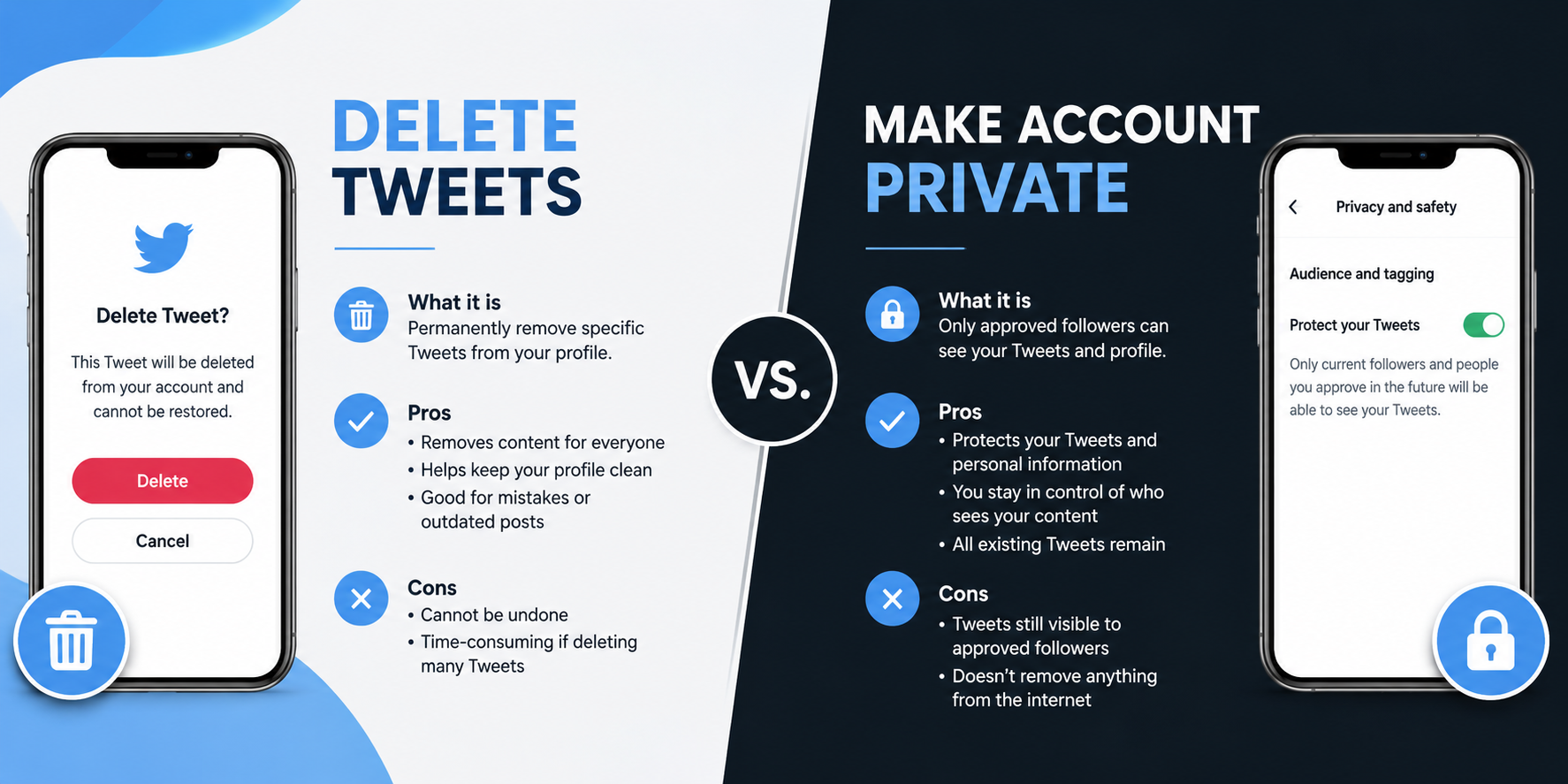
Most people assume that making their X account private is essentially the same as cleaning up their profile. It isn’t. The two approaches operate at completely different levels: one controls who can see your content going forward, while the other removes the content itself. That distinction matters enormously depending on what you’re actually trying to protect yourself from, and over what time horizon you’re thinking.
If your concern is stopping strangers from following your activity starting today, private mode makes perfect sense. But if the concern is what’s already out there – political takes from 2019, complaints about a former employer, offhand jokes that haven’t aged well – many users find that the only real solution is to use this tool from Tweet Delete as part of their cleanup strategy, since it handles bulk deletion of historical content rather than simply restricting who can see it.
Why “Private” Doesn’t Mean “Gone”
Switching your X account to private means new followers must request access before they can see your posts. It keeps your tweets out of public search results and limits who can engage with your content going forward. On paper, that sounds like meaningful protection. In practice, the limitations pile up quickly.
Every person who followed you before you made that change still has complete access to your full posting history. If your account had any stretch of public activity, and for most users who’ve been on the platform for more than a year, it did – that window was long enough for screenshots, quote tweets, and third-party archiving services to capture content. Services like the Wayback Machine index public posts regularly, and none of them un-index content simply because you changed a privacy setting afterward.
The Permanence Problem
This is where the real gap between the two approaches becomes hard to ignore. A private account still holds every tweet you’ve ever posted on X’s servers. The data exists. It’s just hidden from new viewers. Hidden and gone are two entirely different things, and anyone who has watched a controversy unfold on social media knows exactly how fast that distinction collapses when someone goes looking with intent.
Deleting tweets removes the source entirely. When you clear your post history through TweetDelete, you’re not restricting access to content – you’re eliminating it from the platform. There’s no toggle to reverse that. The tweet no longer lives on X’s servers in the same retrievable form that a hidden post does, which is a fundamentally different outcome from adjusting a visibility setting.
TweetDelete is particularly relevant for accounts with years of accumulated posts. X’s own interface only allows you to view and manually delete around 3,200 of your most recent tweets through standard browsing. For anyone who’s been consistently active over several years, that ceiling makes manual deletion functionally useless at scale. TweetDelete’s archive upload feature addresses this directly by processing your full downloaded data file, which X lets users export, meaning your entire tweet history becomes eligible for removal rather than just the most recent portion of it.
When Old Posts Become a Liability
The more you’ve been around on X, the greater the chance that there is something in your past that is no longer you. It is not about hiding or lying about something bad; it is just that people’s opinions, situations and means of communication change over time. A seemingly innocent comment in 2017 may sound quite different in 2026, particularly in light of the many changes that have occurred in the world of platforms, hiring, and public perceptions of language over that period.
In this case, there is no privacy protection in private mode, as the content is still visible to all people who followed you at the time of posting. If you have earned any sort of following during a public period, that audience is still able to see what you posted in your archive. The only way to close this exposure gap is to delete the exposure, not work around it.
TweetDelete also provides continuous protection by automation. Users can set up rules to delete tweets regularly, such as every 30, 60, or 90 days. This ensures that the account’s history is shallow and that no old content builds up gradually, which may be a burden later on. It moves privacy management from being a one-time project to a regular, low-maintenance routine, which is done in the background.
Which One Actually Protects You More?
The direct answer is that it depends on your specific goals, but the two options are not equally powerful across the board. A light-touch solution, making your account private works best if the main concern is limiting future exposure – controlling who sees what you post going forward. It’s fast, reversible, and requires almost no ongoing effort. For users without a substantial posting history who aren’t particularly worried about past content, that may be entirely sufficient for their needs.
For anyone with years of posts, a public-facing career, or real concerns about long-term reputational risk, however, private mode is a surface-level fix. It doesn’t remove anything from the platform. It doesn’t stop determined individuals from accessing your content through existing followers. And it does nothing about posts that have already been captured and circulated beyond X itself.
Conclusion
Deleting your tweet history: systematically, using a tool capable of handling your full archive, is the more durable form of protection because it addresses the actual source of exposure. Less content on the platform means less to find, less to screenshot, and considerably less that can surface at an inconvenient time. The combination of bulk historical deletion and automated ongoing rules creates a meaningfully smaller digital footprint than any privacy setting alone ever could.